Moroccan Cuisine: Traditional Dishes Explained
Introduction
Moroccan food is one of the world’s most celebrated culinary traditions. Yet many people struggle to understand its complexity, layered flavors, and deep cultural roots. Whether you are a food enthusiast, a traveler planning a trip, or a professional chef, understanding traditional Moroccan dishes explained in full context is genuinely rewarding. This guide walks you through the essential dishes, their ingredients, cultural significance, and preparation techniques. By the end, you will understand why Moroccan cuisine consistently ranks among the globe’s top gastronomic traditions — and how to appreciate it far beyond the surface.
—
Key Takeaways
– 🍲 Tagine is Morocco’s most iconic slow-cooked dish, built on centuries of Berber tradition.
– 🌿 Moroccan cuisine blends Arab, Berber, Andalusian, and Sub-Saharan African influences.
– 🧂 Spice mastery — using ras el hanout, saffron, and cumin — defines authentic Moroccan flavor.
– 🥘 Couscous holds deep social and religious significance, traditionally served on Fridays.
– 🥧 Bastilla represents the sweet-savory duality at the heart of Moroccan cooking philosophy.
– 📊 Morocco’s food tourism sector grew by 18% in 2024, partly driven by culinary experiences.
—
The Cultural Roots of Moroccan Food
Moroccan cuisine did not emerge in isolation. Instead, it evolved over more than 2,000 years of cross-cultural exchange. Berber tribes established the foundation — using preserved lemons, olives, and argan oil. Arab invasions introduced spices and complex flavor layering. Later, Andalusian refugees arriving in the 15th century brought refined cooking techniques. Sub-Saharan trade routes contributed saffron, dried fruits, and nuts. This historical convergence created a cuisine of extraordinary depth. According to food historian Dr. Paula Wolfert, *”Moroccan food is perhaps the most sophisticated in the world after French cuisine.”* Each dish carries centuries of cultural memory, making every meal a form of living history.
—
Tagine: The Soul of Moroccan Cooking
What Is a Tagine?
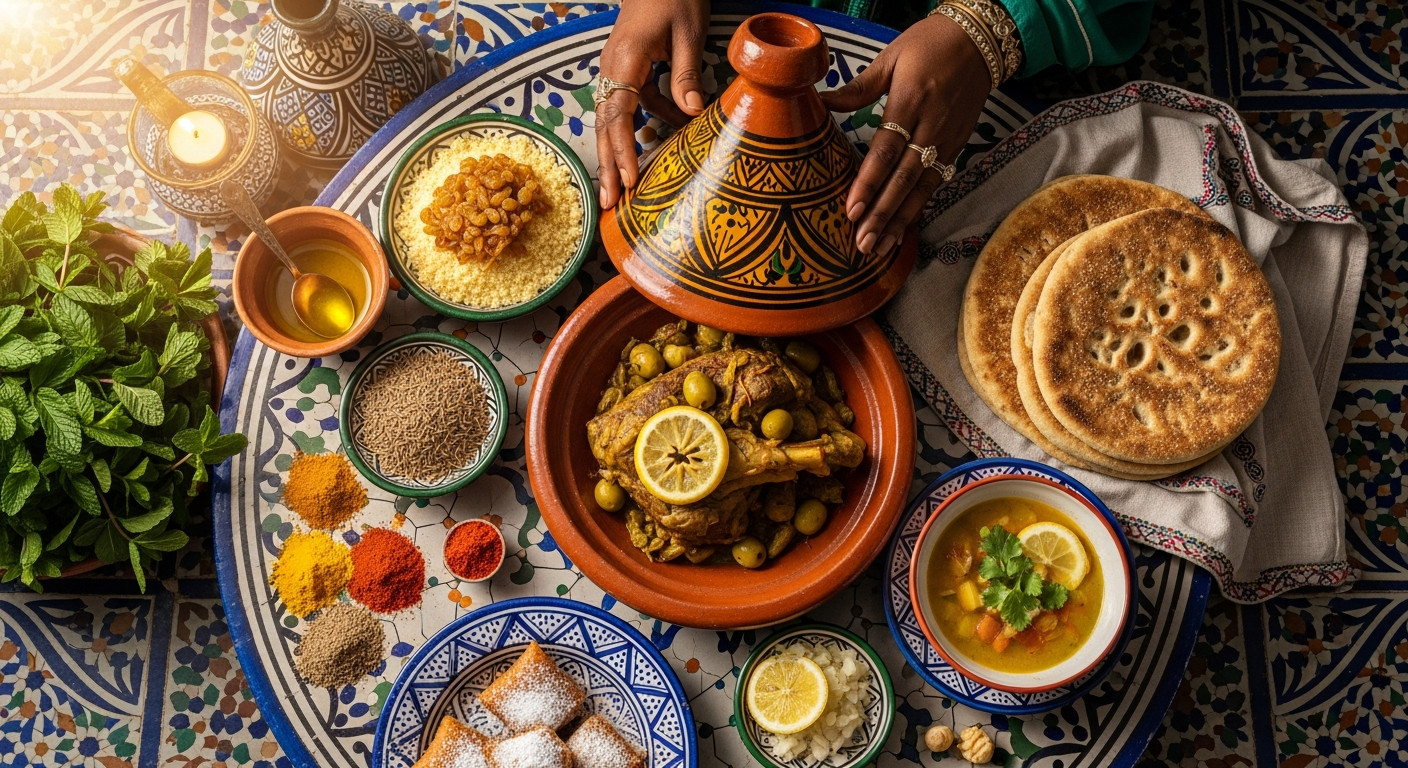
The tagine is both a cooking vessel and a dish. Its conical clay lid creates a self-basting steam cycle. This technique keeps meat incredibly tender and locks in aromatic flavors. A traditional tagine uses very little water — the ingredients essentially cook in their own juices. This method dates back to at least the 9th century, referenced in the *Kitab al-Tabikh*, a medieval Arab cookbook.
Popular Tagine Varieties
| Tagine Type | Key Ingredients | Flavor Profile |
|—|—|—|
| Lamb & Preserved Lemon | Lamb, olives, preserved lemon, saffron | Savory, tangy, aromatic |
| Chicken & Apricot | Chicken, dried apricots, almonds, honey | Sweet-savory, rich |
| Kefta (Meatball) | Spiced minced beef, tomatoes, eggs | Bold, spiced, hearty |
| Vegetable | Chickpeas, carrots, zucchini, paprika | Earthy, warming |
| Fish (Chermoula) | White fish, chermoula marinade, peppers | Fresh, herbal, bright |
A well-prepared lamb tagine typically takes 3 to 4 hours to slow-cook properly. Home cooks in Marrakech often begin preparation the night before, marinating meat in a blend of ras el hanout, ginger, turmeric, and preserved lemon juice.
> *”The tagine is patience made edible. You cannot rush it — and that is precisely its lesson.”*
> — Chef Meryem Cherkaoui, Michelin-recognized Moroccan culinary authority
—
Couscous: More Than Just a Grain
The Friday Tradition
Couscous is Morocco’s national dish. However, it is far more than food — it is ritual. Every Friday after midday prayers, Moroccan families gather for a large communal couscous meal. This tradition is so deeply embedded that Moroccan law once formally recognized Friday couscous as a cultural heritage practice. The dish was officially inscribed on UNESCO’s Intangible Cultural Heritage list in 2020, an acknowledgment shared with Algeria, Tunisia, and Mauritania.
How Authentic Couscous Is Made
Traditional couscous is not boiled — it is steamed three times over a simmering stew in a couscoussier (a two-tiered pot). Each steaming session separates the semolina grains, creating an exceptionally light, fluffy texture. Commercial couscous skips this process entirely, producing a denser, less flavorful result.
| Method | Texture | Time Required | Flavor |
|—|—|—|—|
| Traditional triple steam | Fluffy, light, separated grains | 90–120 minutes | Complex, nutty |
| Commercial instant | Dense, slightly sticky | 5 minutes | Mild, flat |
A traditional seven-vegetable couscous, known as *couscous bsaba khodra*, can include turnips, pumpkin, chickpeas, cabbage, carrots, zucchini, and tomatoes. The broth is seasoned with saffron, ginger, and a generous amount of caramelized onions with raisins.
—
Harira: Morocco’s Beloved Soup
Harira is more than a starter — it is a lifeline. During Ramadan, this thick tomato-and-lentil soup traditionally breaks the fast every evening at *iftar*. A bowl of harira costs roughly 10–20 Moroccan dirhams (approximately $1–$2 USD) at street-side stalls in Fez or Casablanca. It is simultaneously nutritious, inexpensive, and deeply comforting. Consequently, harira has become one of Morocco’s most universally consumed dishes, enjoyed year-round. Key ingredients include tomatoes, chickpeas, lentils, celery, cilantro, vermicelli, and saffron. A small squeeze of lemon and a date on the side complete the traditional serving style.
—
Bastilla: The Art of Sweet-Savory Brilliance
What Makes Bastilla Unique?
Bastilla (also spelled *pastilla* or *b’stilla*) is arguably Morocco’s most technically demanding dish. It layers warqa pastry (a paper-thin dough similar to filo) with pigeon or chicken, eggs, almonds, cinnamon, and saffron. The result is then dusted with powdered sugar and cinnamon on top. This sweet-savory combination startles many first-time tasters. Nevertheless, it consistently earns their admiration. The dish originated with Moroccan Moors returning from Andalusia. It reflects the sophisticated Andalusian flavor philosophy of balancing opposites: rich yet delicate, savory yet sweet.
Bastilla by the Numbers
– Average preparation time: 4–6 hours
– Typical restaurant price in Fez: 120–180 MAD (~$12–$18 USD)
– Pigeon filling: traditional; chicken: common modern substitute
– Warqa pastry sheets used per bastilla: 12–18 layers
> *”Bastilla is Morocco’s answer to fine dining — centuries before anyone coined that term.”*
> — Culinary writer Anissa Helou, author of *Feast: Food of the Islamic World*
—
Moroccan Street Food: Flavor Without Formality
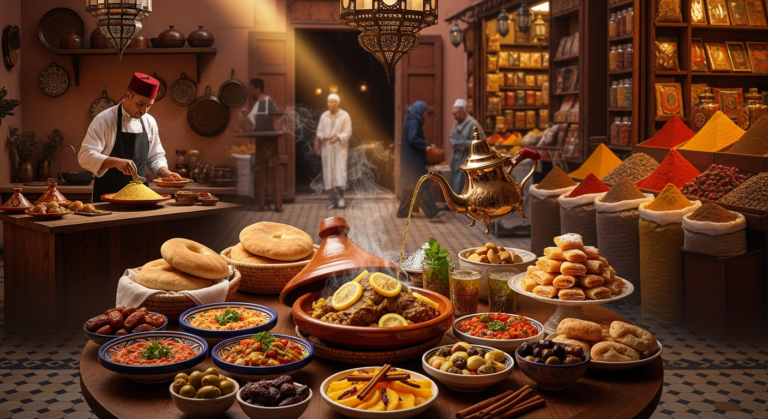
Morocco’s street food scene is vibrant, affordable, and culturally essential. Jemaa el-Fna square in Marrakech is arguably the world’s greatest open-air food market. It attracts over 2 million visitors annually and has been recognized by UNESCO as an Oral and Intangible Heritage site. Popular street foods include:
– Msemen — flaky square flatbread, often filled with honey and butter
– Makouda — crispy fried potato fritters served with harissa sauce
– Brochettes — skewered spiced lamb or beef, grilled over charcoal
– Sfenj — Moroccan doughnuts dusted with sugar, sold for 2–3 MAD each
– Merguez — spiced lamb sausages, a North African staple
Each item reflects the broader Moroccan culinary ethos: maximum flavor from minimal, honest ingredients. Furthermore, street food in Morocco remains deeply community-oriented — vendors often know their regular customers by name and preference.
—
The Spice Architecture of Moroccan Cooking
Ras El Hanout: King of Spice Blends
No discussion of Moroccan food is complete without examining *ras el hanout*. The name translates literally to “top of the shop” — implying the finest spices a merchant offers. A traditional blend may contain anywhere from 12 to 35 different spices, including cardamom, rose petals, mace, coriander, and cinnamon. Each spice merchant in Fez or Marrakech formulates their own proprietary blend.
Core Moroccan Spice Reference Table
| Spice | Moroccan Name | Primary Use |
|—|—|—|
| Cumin | *Kamoun* | Tagines, soups, kefta |
| Saffron | *Zaafrane* | Couscous, bastilla, harira |
| Cinnamon | *Qarfa* | Bastilla, desserts, tagines |
| Ginger | *Skinjbir* | Tagines, harira |
| Paprika | *Felfa hamra* | Chermoula, fish dishes |
| Turmeric | *Kharkoum* | Chicken tagines, soups |
| Preserved Lemon | *Hamad M’rakad* | Tagines, salads |
Moroccan cooks rarely measure spices. Instead, they rely on sensory intuition built through years of practice. This tacit knowledge is typically passed from mother to daughter across generations.
—
Moroccan Desserts and Tea Culture
Sweets That Complete the Meal
Moroccan desserts emphasize almonds, honey, orange blossom water, and sesame. Popular confections include *kaab el ghazal* (gazelle horns — crescent-shaped almond pastries), *chebakia* (sesame and honey cookies traditional during Ramadan), and *m’hancha* (a coiled almond snake pastry). These are rarely overly sweet. Instead, they offer a refined, perfumed sweetness that complements mint tea beautifully.
The Ritual of Moroccan Mint Tea
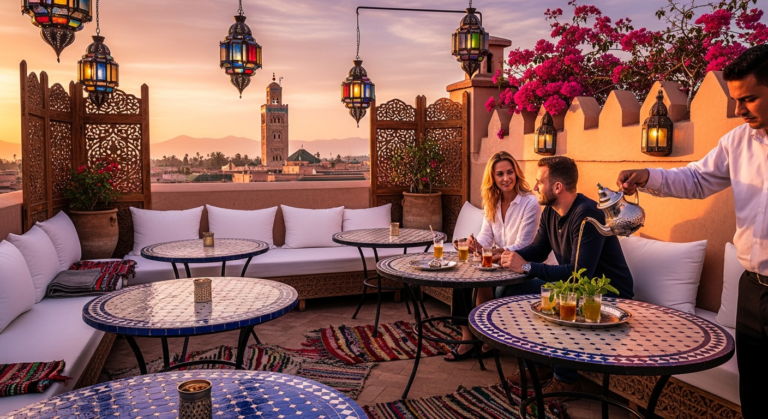
Moroccan mint tea — *atay* — is not simply a beverage. It is a social ceremony. Gunpowder green tea is brewed with fresh spearmint leaves and large amounts of sugar. Crucially, the tea is poured from a great height to create foam. This theatrical pour aerates the tea and symbolizes hospitality. Declining tea in a Moroccan home is considered impolite. As the saying goes: *”The first glass is gentle as life, the second is strong as love, the third is bitter as death.”*
—
FAQs
Q: What is the most popular traditional Moroccan dish?
A: Tagine and couscous are the most widely recognized. Tagine is more versatile; couscous holds deeper ritual significance.
Q: Is Moroccan food very spicy hot?
A: No. Moroccan food is richly spiced but rarely chili-hot. The focus is on aromatic complexity, not heat.
Q: What does ras el hanout taste like?
A: Warm, floral, and complex — with notes of cinnamon, rose, ginger, and cardamom. No two blends taste identical.
Q: Can vegetarians enjoy Moroccan cuisine?
A: Absolutely. Many tagines, salads, harira, and couscous dishes are naturally vegetarian or easily adapted.
Q: How long does it take to prepare an authentic tagine?
A: Minimum 3 hours of slow cooking. Marinating overnight beforehand is strongly recommended for optimal flavor.
Q: What is the best city in Morocco for food tourism?
A: Fez is widely considered Morocco’s culinary capital, though Marrakech rivals it for variety and street food culture.
—
Conclusion
Moroccan cuisine is a living archive of history, culture, and artistry. From the slow patience of a perfectly cooked tagine to the theatrical pour of mint tea, every element carries meaning. Understanding traditional Moroccan dishes means understanding Morocco itself — its warmth, its complexity, and its extraordinary generosity. As global interest in authentic culinary experiences continues growing in 2025 and beyond, Moroccan food stands as one of the world’s most rewarding gastronomic journeys. Start with a tagine. Follow it with harira. Finish with mint tea. That simple sequence will tell you more about Morocco than any guidebook ever could.
—
References
– UNESCO Intangible Cultural Heritage — Couscous inscription, 2020: [ich.unesco.org](https://ich.unesco.org)
– Wolfert, Paula. *The Food of Morocco*. Ecco Press, 2011.
– Helou, Anissa. *Feast: Food of the Islamic World*. Ecco Press, 2018.
– Morocco World News — Food tourism growth data, 2024: [moroccoworldnews.com](https://www.moroccoworldnews.com)
– Mourad Lahlou. *Mourad: New Moroccan*. Artisan Books, 2011.
– Oxford Companion to Food — Moroccan cuisine entry. Oxford University Press, 2014.