Exploring Morocco by Train: The Insider’s Guide
Introduction
There is a smarter, more immersive way to discover North Africa’s most captivating country. Exploring Morocco by train unlocks a network of landscapes, cultures, and cities that few travelers experience at ground level. Yet many visitors overlook rail travel entirely, defaulting to expensive flights or chaotic shared taxis. The result? They miss the slow-burn beauty of the Moroccan interior. This guide covers everything you need to know — from ticket prices and routes to onboard comfort and insider tips — so your journey between ancient medinas and Atlantic coasts becomes an adventure in itself, not just a transit.
—
Key Takeaways
– 🚆 Morocco’s national rail network, ONCF, connects all major cities efficiently and affordably.
– 💰 Second-class tickets between Casablanca and Marrakech cost approximately MAD 100–130 (~USD 10–13).
– 🗺️ The Al Boraq high-speed train reaches 320 km/h, linking Casablanca and Tangier in under 2 hours.
– 🏨 First-class coaches offer air conditioning, reclining seats, and Wi-Fi on select routes.
– 📅 Book tickets at least 48 hours in advance during peak season (July–August & Ramadan).
– ⚠️ Rail coverage does not extend to Merzouga or Chefchaouen — buses fill those gaps.
—
Morocco’s Rail Network: An Overview
Morocco’s national rail operator, ONCF (*Office National des Chemins de Fer*), manages roughly 2,400 km of track across the country. The network is one of Africa’s most modern and reliable. Key hubs include Casablanca, Rabat, Fès, Marrakech, and Tangier. As of 2025, ONCF has invested heavily in fleet modernization. The system carries approximately 40 million passengers annually, according to ONCF’s 2024 operational report. For international travelers, rail travel offers a sustainable, cost-effective alternative to domestic flights. Furthermore, trains often deposit passengers closer to city centers than airports do.
—
The Al Boraq: Africa’s First High-Speed Rail
Speed, Comfort, and Innovation
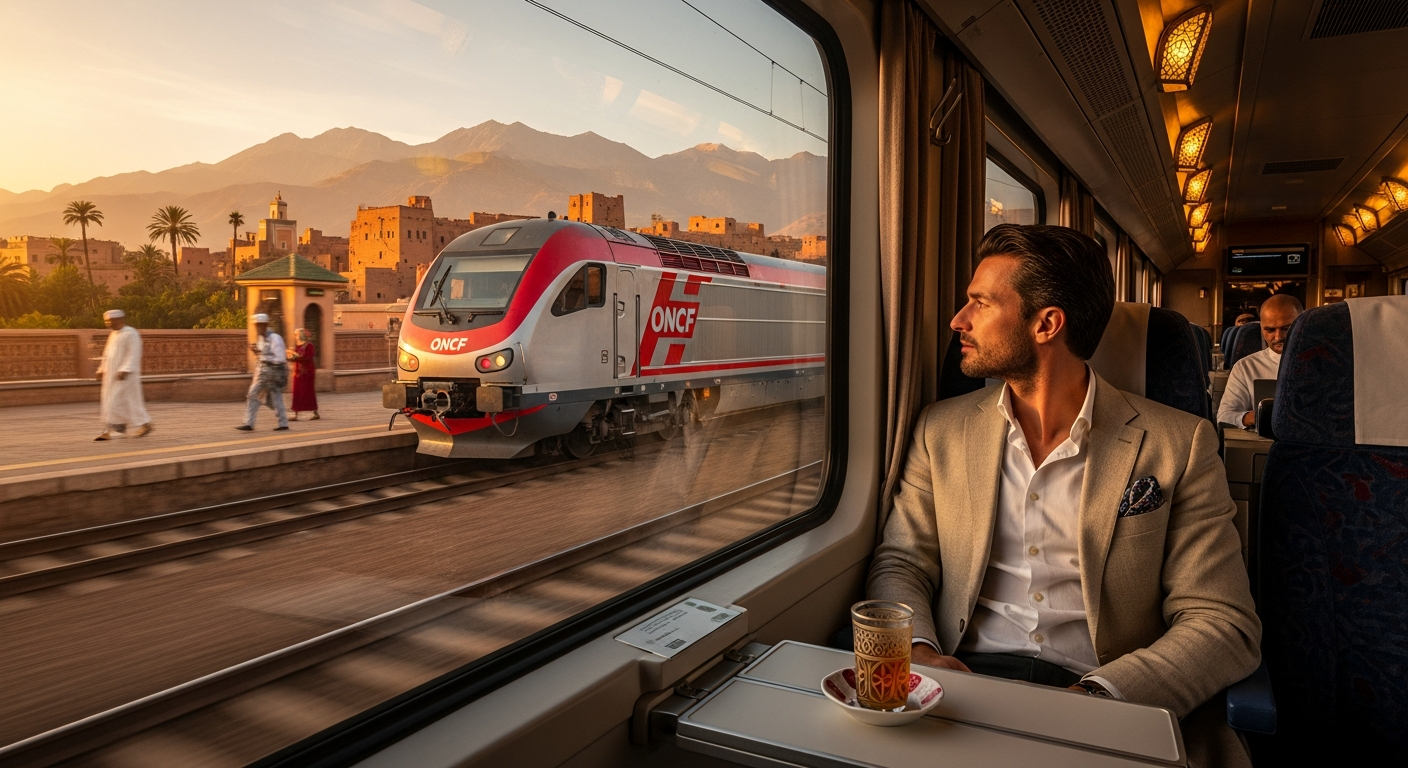
Launched in 2018, the Al Boraq (LGV Maroc) was a landmark achievement. It connects Tangier-Ville to Casablanca Casa Voyageurs in approximately 2 hours 10 minutes. The train reaches a maximum commercial speed of 320 km/h. Ticket prices in first class start at around MAD 293 (~USD 29), while second class costs roughly MAD 213 (~USD 21). The onboard experience includes leather seating, individual power outlets, and panoramic windows. The journey passes through rolling Rif foothills and coastal plains. It is genuinely one of Africa’s most scenic high-speed rail experiences.
| Route | Duration | 2nd Class (MAD) | 1st Class (MAD) |
|—|—|—|—|
| Tangier → Casablanca | ~2h 10min | ~213 | ~293 |
| Tangier → Rabat | ~1h 30min | ~155 | ~215 |
| Casablanca → Rabat | ~38 min | ~55 | ~90 |
—
Classic Routes Worth Riding
Casablanca to Marrakech
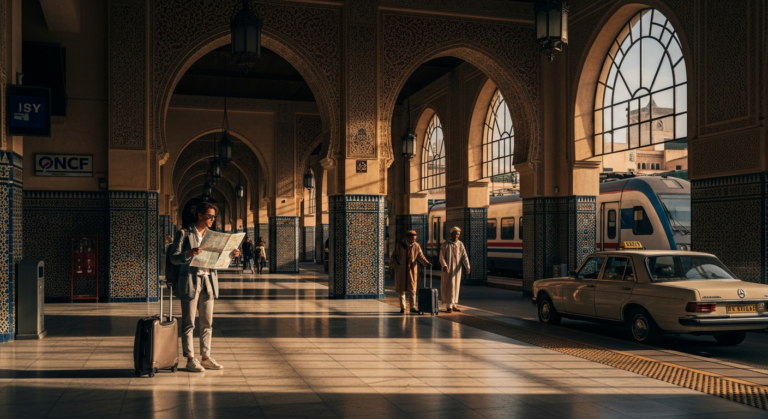
This is arguably the most popular rail corridor in Morocco. The journey takes approximately 3 hours and passes through the fertile plains of Chaouia. Departures run frequently — roughly every 2 hours between 6:00 AM and 10:00 PM. Tickets cost between MAD 100 and MAD 160, depending on class and timing. This route suits both budget travelers and business passengers equally well. The Casablanca Casa Voyageurs station itself is an architectural gem worth arriving early to explore. Additionally, the Marrakech terminus sits walking distance from Djemaa el-Fna square.
Fès to Casablanca
The Fès–Casablanca corridor runs through Morocco’s heartland. Travel time is roughly 4 hours 30 minutes via direct service. This route passes through Meknès, one of Morocco’s four Imperial Cities. Travelers can disembark at Meknès for a same-day visit and reboard a later train. Fares range from MAD 115 (second class) to MAD 165 (first class). Morning departures from Fès around 7:00 AM consistently receive strong passenger reviews for punctuality. Indeed, ONCF reports an on-time performance rate of approximately 88% on this corridor in 2024.
Rabat to Tangier
For those traveling north toward the Mediterranean and Europe, the Rabat–Tangier route is essential. The journey takes around 3 hours 30 minutes by Al Boraq-connected services. Scenic highlights include coastal Atlantic views near Kenitra and forested hills approaching Tangier. The Tangier-Ville station connects seamlessly to the Tangier-Med ferry terminal via bus. Consequently, this route serves as a popular gateway for travelers crossing into Spain or Portugal. First-class tickets on this route hover around MAD 200–220, providing excellent value for the distance covered.
—
Ticket Booking: What You Need to Know
Buying Online vs. At the Station
ONCF’s official website and mobile app (ONCF Voyageurs) offer online booking. Tickets can be purchased up to 30 days in advance. However, the interface is primarily in French and Arabic. A practical workaround is using third-party platforms like Trainline or Omio, which support English. At station counters, queues can be lengthy during peak periods. Therefore, digital booking is strongly recommended. Travelers with a Moroccan bank card or international Visa/Mastercard can complete payment online without issues. E-tickets are accepted on most services via a QR code scan at the gate.
> Expert Tip: *”Always validate your ticket at the platform gate before boarding — unmarked e-tickets occasionally trigger alarms at automated barriers.”*
> — Karim Bennani, certified Moroccan tour guide, Fès (2024)
Fare Classes and What They Include
| Class | Price Range | Features |
|—|—|—|
| 2nd Class | MAD 100–213 | Air-conditioned, assigned seating |
| 1st Class | MAD 160–293 | Wider seats, more legroom, quieter |
| Al Boraq 1st | MAD 293+ | Leather seats, power outlets, Wi-Fi |
| Night Train | MAD 200–350 | Couchette berths (selected routes) |
—
Practical Tips for a Smooth Journey
What to Pack and Expect
Train stations in Morocco maintain moderate to good cleanliness overall. However, carry small change (MAD 2–5) for luggage storage facilities. Tap water on trains is not reliably safe for drinking — pack a reusable bottle filled at your hotel. Onboard vendors selling Moroccan mint tea, coffee, and snacks pass through regularly. Furthermore, the café car on Al Boraq and longer intercity services provides light meals starting at MAD 25. Phone charging is available in first class. Wi-Fi is available on Al Boraq trains, though speeds vary between urban and rural stretches.
Safety, Luggage, and Station Etiquette
Morocco’s trains are generally safe and well-monitored. Petty theft, while uncommon, does occur at busy stations like Casablanca Casa Voyageurs. Keep bags close during boarding. Luggage racks above seats accommodate standard-sized suitcases. However, oversized backpacks may need to be stored in the space between coach sections. ONCF regulations technically limit luggage to 30 kg per passenger, though enforcement is inconsistent. Notably, women traveling alone consistently report feeling secure on Moroccan trains, with conductors actively maintaining order onboard.
—
Combining Rail with Other Transport
Bridging the Gaps: Bus and Grand Taxi
Not every Moroccan destination is rail-accessible. Merzouga (Sahara), Chefchaouen, Essaouira, and Ouarzazate all require onward connections. The efficient approach is to pair ONCF trains with CTM or Supratours buses, which coordinate schedules with rail arrivals in several cities. For example, Marrakech station connects directly to a Supratours bus terminal for Essaouira (roughly 3 hours, MAD 80). Grand taxis — shared long-distance taxis — also depart from near most train stations. These cover short regional gaps quickly and cheaply. Consequently, a well-planned itinerary can use rail as a backbone and buses as connectors.
Sample 7-Day Rail Itinerary
| Day | Route | Transport |
|—|—|—|
| 1–2 | Casablanca → Rabat | Al Boraq (~38 min) |
| 3 | Rabat → Fès | ONCF Train (~3h 30min) |
| 4 | Fès Day | Explore medina |
| 5 | Fès → Marrakech | ONCF Train (~7h or change at Casa) |
| 6–7 | Marrakech → Essaouira | Supratours Bus (~3h) |
—
Testimonials from Real Travelers
> *”The Al Boraq from Tangier to Casablanca was genuinely one of the smoothest train rides I’ve ever taken — comparable to Eurostar in comfort.”*
> — Sophie M., French traveler, 2024
> *”I did the Fès–Casablanca route as a solo female traveler. The conductor checked in on me twice. I felt completely at ease.”*
> — Amara T., Canadian travel blogger, 2025
—
Environmental Impact of Choosing Rail
Choosing trains over domestic flights in Morocco carries measurable environmental benefits. A Casablanca–Marrakech flight emits approximately 89 kg of CO₂ per passenger, compared to 6–12 kg for the equivalent train journey, based on European Environment Agency estimation models applied to Morocco’s grid mix. ONCF has committed to a 15% reduction in energy consumption per passenger-kilometer by 2030, as stated in their Green Mobility Strategy 2030 report. For eco-conscious travelers, rail is clearly the responsible choice. Moreover, choosing trains supports local economies through station communities and onboard vendors throughout the journey.
—
FAQ
Q: Is it safe to travel by train in Morocco?
A: Yes. Morocco’s trains are monitored by ONCF staff and security personnel. Petty theft near stations is the main risk — keep valuables secure during boarding.
Q: Can I buy train tickets in Morocco without a Moroccan bank card?
A: Yes. International Visa and Mastercard are accepted online. At station counters, cash (Moroccan Dirham) is the most reliable payment method.
Q: How far in advance should I book train tickets?
A: For routine travel, 24–48 hours is sufficient. For peak seasons (July–August, Eid), book 1–2 weeks ahead to secure preferred seating.
Q: Does the Al Boraq require a separate reservation?
A: Yes. Al Boraq is a premium service requiring a seat reservation in addition to a fare payment. Online booking through ONCF or third-party platforms handles this automatically.
Q: Are there overnight trains in Morocco?
A: Yes. ONCF operates overnight trains with couchette berths on select routes, such as Marrakech to Tangier. Prices range from MAD 200–350 depending on class and route.
Q: Is there a rail pass for tourists visiting Morocco?
A: Currently, ONCF does not offer a multi-day tourist rail pass equivalent to Eurail. Individual point-to-point tickets remain the standard booking method.
—
Conclusion
Morocco’s rail network is a genuinely underutilized asset for international travelers. From the breathtaking speed of Al Boraq to the leisurely rhythm of intercity routes through Imperial Cities, train travel here offers depth that planes and buses simply cannot match. The costs are low, the scenery is extraordinary, and the logistics — once understood — are surprisingly straightforward. Pair ONCF trains with strategic bus connections, plan your bookings 48 hours ahead during quieter periods, and always travel first class on overnight services for comfort. Morocco by rail is not merely a mode of transit; it is the journey itself.
—
References
– ONCF Official Website — Morocco’s national rail operator schedules and fares: [www.oncf.ma](https://www.oncf.ma)
– African Development Bank Report on Al Boraq High-Speed Rail, 2023.
– ONCF Green Mobility Strategy 2030 — Internal sustainability commitment report, 2024.
– European Environment Agency — CO₂ emissions comparison methodology (rail vs. aviation), 2023.
– Lonely Planet Morocco, 2024 Edition — practical rail travel guidance.
– World Bank Transport Report: Rail Investment in North Africa, 2023.