Morocco Visa Guide: Everything Travelers Must Know
Introduction
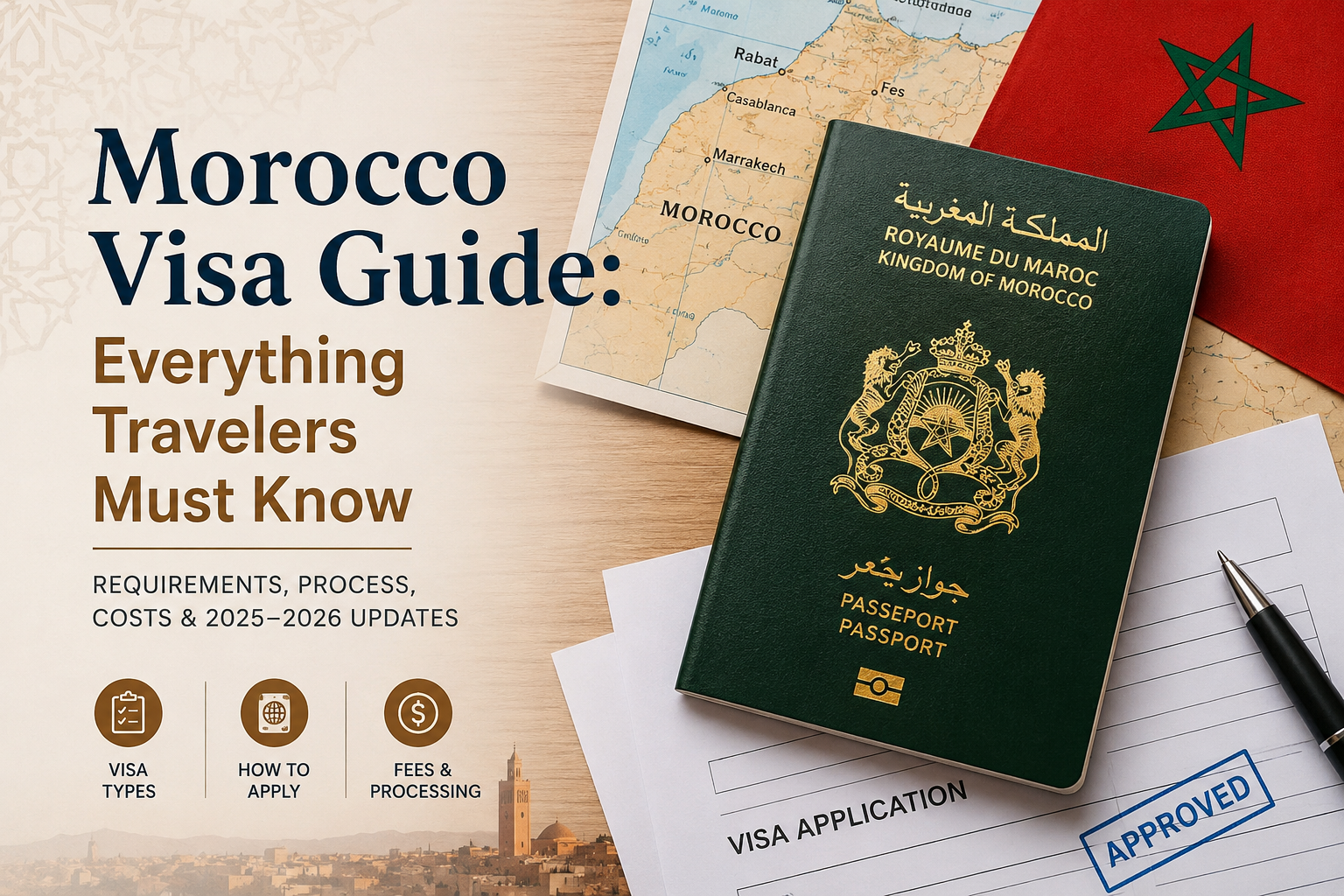
Planning a trip to Morocco raises one immediate question: do you need a visa? The answer depends heavily on your nationality, trip purpose, and intended length of stay. This Morocco visa guide for travelers breaks down every critical detail — from visa-free access to application procedures, costs, and 2025–2026 updates. Whether you are a first-time visitor or a seasoned explorer, understanding Morocco’s entry requirements saves time, money, and stress. By the end of this article, you will know exactly which visa category applies to you, what documents to prepare, and what common mistakes to avoid at the border.
—
Key Takeaways
– 🌍 Over 90 nationalities currently enjoy visa-free entry to Morocco.
– 📋 Most tourist visas allow stays of up to 90 days.
– 💰 Standard visa application fees range from $20 to $80 USD depending on nationality.
– 🏛️ Applications are typically processed through Moroccan embassies or consulates.
– ⏱️ Processing times range from 5 to 15 business days.
– 🔄 Morocco updated several bilateral agreements in 2024–2025, expanding visa-free access for new nationalities.
—
Who Needs a Visa for Morocco?
Visa-Free Nationalities
Morocco maintains generous visa-free policies with dozens of nations. Citizens from the United States, United Kingdom, European Union, Canada, and Australia can enter without a visa for stays up to 90 days. Additionally, most Gulf Cooperation Council (GCC) nationals now enjoy streamlined access following updated 2024 agreements. Morocco’s Ministry of Foreign Affairs confirmed these expansions in a 2024 official communiqué. Furthermore, travelers from Japan, South Korea, and Brazil also benefit from this policy. However, travelers must carry a valid passport with at least six months of remaining validity. Always verify your specific country’s status before booking flights.
Nationalities Requiring a Visa
Travelers from many African, South Asian, and some Middle Eastern countries must obtain a visa before arrival. This includes nationals from Pakistan, India, Nigeria, Bangladesh, and several others. Morocco does not currently offer visa-on-arrival for most restricted nationalities. Therefore, advance planning is essential. Interestingly, diplomatic progress in 2025 expanded access slightly for certain ECOWAS nations. Nevertheless, travelers in this category must apply through their nearest Moroccan embassy. Failing to do so results in denied boarding or deportation at Moroccan ports of entry, which creates costly disruptions.
—
Types of Morocco Visas
Tourist Visa (Type C)
The tourist visa is the most commonly requested visa for Morocco. It is designed for short stays of up to 90 days within a 180-day period. This visa covers sightseeing, family visits, and cultural tourism. Applicants must demonstrate sufficient financial means — approximately €50 per day is the standard benchmark. Moreover, proof of accommodation and a return ticket are mandatory. Single-entry versions cost approximately $30–$50 USD, while multiple-entry versions may reach $80 USD. Processing typically takes 5 to 10 business days. Notably, this visa does not permit employment or business activities inside Morocco.
Business Visa
Business travelers who need to attend conferences, meetings, or negotiate contracts require a business visa. This category requires an official invitation letter from a Moroccan company or organization. The letter must be notarized and translated into Arabic or French if originally in another language. Furthermore, applicants must present a bank statement covering at least the last three months. Business visas are typically granted for 30 to 90 days, with single or multiple entries available. Fees average around $50–$80 USD. According to trade data, Morocco welcomed over 1.2 million business visitors in 2023, underscoring its growing commercial importance globally.
Student Visa (Type D)
Students enrolled at Moroccan universities or language institutes need a long-stay student visa. This visa is renewable annually and allows residence for the duration of the academic program. Applicants must provide proof of enrollment from an accredited Moroccan institution. Additionally, a clean criminal background check and medical certificate are required. The student visa fee is approximately $40–$60 USD. Morocco hosts around 12,000 international students annually, according to Ministry of Higher Education figures. Consequently, universities in Rabat, Casablanca, and Fes are increasingly popular among African and European students seeking affordable, quality education.
Transit Visa
Travelers connecting through Mohammed V International Airport (Casablanca) without leaving the international zone generally do not require a transit visa. However, passengers who must exit the secure area during a layover may need one. Transit visa fees are typically lower, around $15–$25 USD. Processing times are shorter as well, usually 2 to 5 business days. Airlines operating through Casablanca strongly advise double-checking transit requirements before travel. Royal Air Maroc, for instance, publishes updated transit advisories on its official booking portal. Always confirm your status at least two weeks before departure to avoid last-minute complications.
—
Morocco Visa Requirements: Document Checklist
| Document | Details Required |
|—|—|
| Valid Passport | Minimum 6 months validity beyond travel dates |
| Completed Application Form | Signed, dated, and fully filled |
| Passport-Sized Photos | 2 recent photos, white background, ICAO-compliant |
| Flight Reservation | Confirmed return or onward ticket |
| Hotel Booking / Invitation | Proof of accommodation for entire stay |
| Bank Statement | Last 3 months, showing sufficient funds |
| Travel Insurance | Coverage minimum €30,000, valid in Morocco |
| Cover Letter | Explaining purpose and duration of visit |
> Expert Tip: “Incomplete applications are the single most common reason for Morocco visa rejections. Submit every document listed, even if it seems redundant.” — *Senior Immigration Consultant, Paris 2024*
—
How to Apply for a Morocco Visa
Step-by-Step Application Process
Applying for a Morocco visa follows a structured procedure. First, identify the nearest Moroccan embassy or consulate in your country of residence. Second, download and complete the official application form from the embassy’s website. Third, gather all required documents listed in the checklist above. Fourth, submit your complete application in person or by registered mail where postal applications are accepted. Fifth, pay the applicable visa fee — only cash or certified checks are accepted at most Moroccan consulates. Finally, await processing and collect your passport once the visa is stamped. Tracking mechanisms vary by country, so inquire about status updates directly with the consulate.
Online Application (E-Visa Pilot)
Morocco launched a pilot e-visa program in late 2023, progressively expanding it through 2025. Currently, selected nationalities can apply online through the official Moroccan e-visa portal. The system allows upload of digital documents and payment via international credit card. Processing through the e-visa system averages 7 business days. However, not all nationalities qualify for this streamlined channel yet. The Moroccan government plans to expand the e-visa program to additional countries by 2026. This initiative aligns with Morocco’s broader digital transformation agenda under Vision 2030. Travelers should check current eligibility directly on Morocco’s official immigration authority website.
—
Visa Fees by Nationality
| Nationality Group | Tourist Visa Fee | Multiple-Entry Fee | Processing Time |
|—|—|—|—|
| US / UK / EU (when required) | $30–$50 USD | $60–$80 USD | 5–10 days |
| South Asian nationals | $40–$60 USD | $70–$90 USD | 7–15 days |
| African nationals (non-exempt) | $25–$50 USD | $55–$75 USD | 7–12 days |
| Transit visa (all) | $15–$25 USD | N/A | 2–5 days |
*Fees are indicative and subject to change. Always confirm with the relevant Moroccan consulate.*
—
Border Entry Tips and Common Mistakes
What to Expect at Moroccan Borders
Morocco’s major entry points include Casablanca Mohammed V Airport, Marrakech Menara Airport, Tangier-Ibn Battuta Airport, and several land borders with Spain and Mauritania. Border officers conduct standard immigration checks, including passport inspection, biometric data collection, and occasionally financial proof verification. Travelers should carry physical copies of all documents, even if visas are electronic. Furthermore, customs rules limit cash imports to 100,000 MAD (approximately $10,000 USD). Directional signs at major airports are bilingual in Arabic and French, with English assistance available at main counters.
Most Common Visa Mistakes
Travelers frequently make avoidable errors during the Morocco visa process. The most common mistake is underestimating document requirements. Another frequent error is applying too close to departure — always allow at least three weeks for processing. Submitting expired or low-quality photographs also causes instant rejections. Additionally, some travelers misunderstand the 90-day rule, assuming it resets automatically after a brief exit. In reality, Moroccan immigration officers track cumulative stay duration. Overstaying a visa in Morocco results in fines, potential detention, and travel bans. One traveler case in 2024 reported a 2,000 MAD fine for a 10-day overstay.
—
Extending Your Stay in Morocco
Visa extensions in Morocco are possible but require early action. Travelers must apply at the Service des Etrangers (Foreigners’ Service) within their local prefecture before their current visa expires. Extensions are not guaranteed and are granted at the discretion of immigration authorities. Applicants typically need renewed proof of accommodation, financial means, and a valid reason for extension. Health emergencies or documented unforeseen circumstances generally strengthen extension requests. Most approved extensions grant an additional 30 days. Repeated extension requests are viewed with scrutiny. Alternatively, some travelers exit to Spain via Ceuta or Melilla and re-enter, though this practice is subject to increased officer scrutiny since 2024.
—
FAQs
Q: Can I get a Morocco visa on arrival?
A: Morocco does not offer visa-on-arrival for most nationalities. Apply in advance through your nearest Moroccan embassy.
Q: How long can I stay in Morocco without a visa?
A: Most visa-exempt nationalities may stay up to 90 days within any 180-day period.
Q: Is Morocco safe for tourists in 2025–2026?
A: Morocco is generally considered safe for tourists. The Global Peace Index 2024 ranks it among Africa’s more stable destinations.
Q: Can I work on a tourist visa in Morocco?
A: No. Working on a tourist visa is strictly prohibited and can result in deportation and re-entry bans.
Q: Does Morocco have an e-visa for all nationalities?
A: Not yet. The e-visa pilot currently covers select nationalities, with broader rollout planned for 2026.
Q: What currency is accepted for visa fees?
A: Most consulates accept local currency equivalents, USD, or Euros. Credit card acceptance varies by location.
—
Conclusion
Morocco remains one of the world’s most accessible and rewarding destinations for international travelers. Understanding its entry requirements is the essential first step toward a seamless visit. This guide has covered visa-free access, visa types, document requirements, fees, and border tips. Most importantly, always verify current requirements directly with the Moroccan embassy in your home country, as policies evolve. Apply early, prepare thoroughly, and carry both digital and physical copies of your documents. With proper preparation, your Moroccan adventure — from the medinas of Fes to the dunes of Merzouga — begins smoothly at the first checkpoint.
—
References
– Morocco Ministry of Foreign Affairs — [www.diplomatie.ma](https://www.diplomatie.ma) — Official visa and bilateral agreement updates.
– IATA Travel Centre — [www.iatatravelcentre.com](https://www.iatatravelcentre.com) — Global passport and visa requirement database.
– Henley Passport Index 2024 — [www.henleypassportindex.com](https://www.henleypassportindex.com) — Visa-free access rankings by nationality.
– Morocco National Tourism Office (ONMT) — [www.visitmorocco.com](https://www.visitmorocco.com) — Official tourism and entry guidance.
– Global Peace Index 2024 — Institute for Economics & Peace — Annual safety ranking data.