Agadir Travel Guide: What First-Timers Must Know
Introduction
Planning your first trip to Morocco’s sun-soaked Atlantic coast can feel overwhelming. Where do you stay? What do you eat? Is it safe? This Agadir travel guide for first-time visitors answers every critical question. Agadir is Morocco’s most beach-friendly city — rebuilt after a devastating 1960 earthquake, it now welcomes over 3 million tourists annually. Unlike Marrakech or Fez, Agadir offers a relaxed, modern atmosphere. It blends Moroccan authenticity with European-style comfort. This guide covers the best time to visit, top neighborhoods, local cuisine, hidden gems, safety, and practical budgeting. Whether you fly in from London, Paris, or New York, you will leave Agadir with unforgettable memories. Read carefully — every section is designed to help you travel smarter, spend less, and experience more.
—
Key Takeaways
– ✅ Best time to visit: April–June and September–November for ideal weather
– ✅ Average daily budget: €50–€120 depending on accommodation style
– ✅ Top experience: Agadir Beach, Souk El Had, and Kasbah Hill sunset
– ✅ Getting around: Petits taxis are cheap (€1–€3 per ride) and widely available
– ✅ Safety rating: Agadir ranks among Morocco’s safest cities for foreign tourists
– ✅ Language tip: French and Darija (Moroccan Arabic) dominate; English is growing in tourist areas
—
Why Agadir Stands Out Among Moroccan Cities
Agadir is not a typical Moroccan medina city. After the catastrophic 1960 earthquake that killed over 15,000 people, Agadir was redesigned with wide roads, modern buildings, and a planned beach resort zone. This makes it uniquely accessible for first-time visitors. Furthermore, Agadir serves as the capital of the Souss-Massa region — Morocco’s agricultural heartland. The city produces 80% of Morocco’s citrus exports. Today, it balances tourism, fishing, and commerce seamlessly. The contrast is striking: ultra-modern beachfront hotels coexist alongside traditional Amazigh (Berber) markets. Consequently, visitors enjoy a dual experience — modern convenience meets ancient culture. This is precisely why experienced travelers repeatedly return to Agadir over any other Moroccan coastal city.
—
Best Time to Visit Agadir
Seasonal Overview
Agadir enjoys a semi-arid climate with over 300 sunny days per year. However, timing your visit still matters significantly. The table below outlines each season’s key characteristics:
| Season | Months | Avg. Temperature | Crowd Level | Best For |
|—|—|—|—|—|
| Spring | Apr–Jun | 22–26°C | Moderate | Beach, hiking, culture |
| Summer | Jul–Aug | 28–32°C | Very High | Beach, nightlife |
| Autumn | Sep–Nov | 22–27°C | Moderate | Budget travel, quieter beaches |
| Winter | Dec–Mar | 15–20°C | Low | Surfing, budget deals |
> Expert Tip: *”April and October are Agadir’s sweet spots — warm enough for swimming, cool enough for sightseeing, and affordable enough to stretch your budget.”* — Moroccan Tourism Board Advisor, 2024
Spring and autumn consistently offer the best overall experience. Summer is ideal for beach lovers but expect higher hotel prices, often 30–50% above off-season rates. Surfers, however, prefer the Atlantic swells of winter months.
—
Where to Stay in Agadir
Top Neighborhoods for First-Time Visitors
Choosing the right neighborhood shapes your entire trip. Therefore, understanding each district before booking is essential.
🏖️ The Beach Boulevard (Bord de Mer)
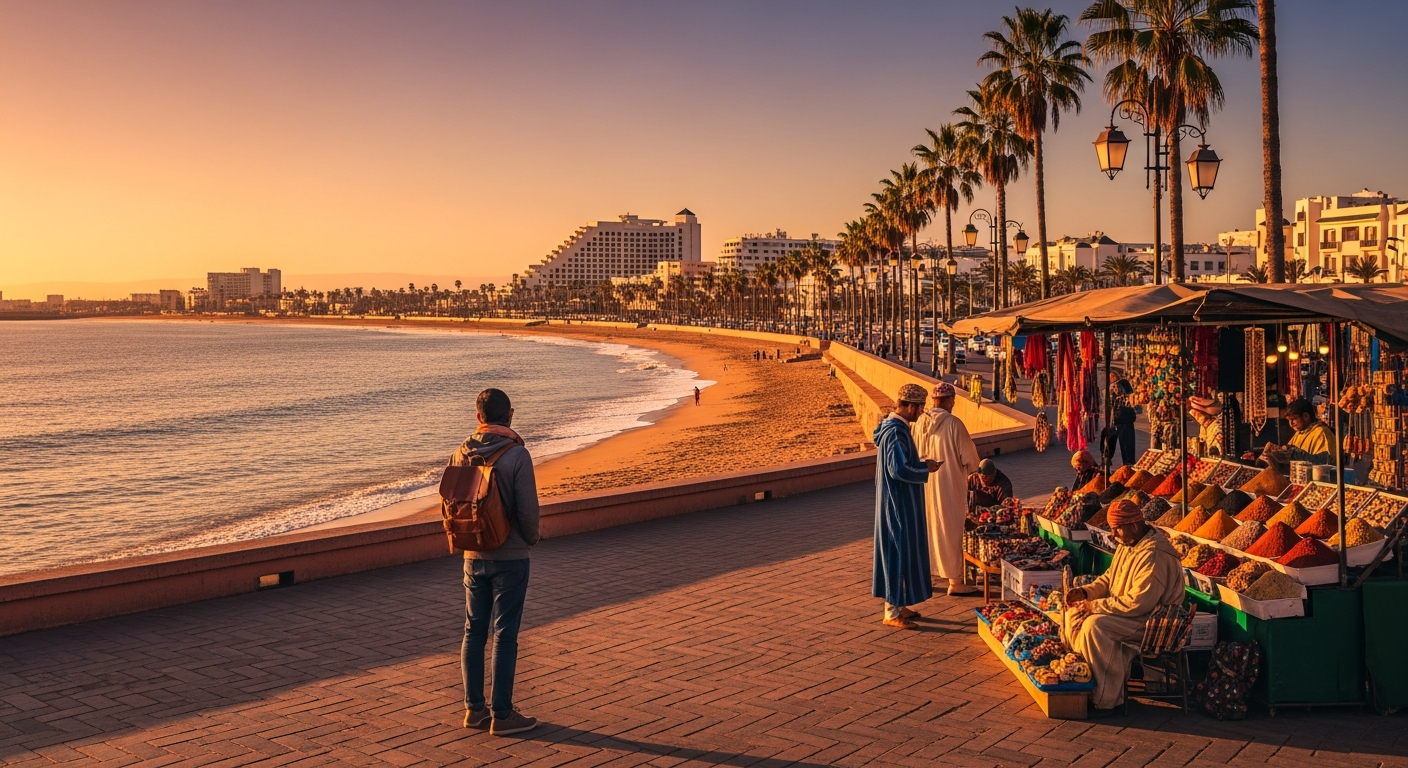
This is Agadir’s tourist spine. Luxury hotels, restaurants, and beach clubs run along this 6km crescent coastline. Expect to pay €80–€200/night for quality beachfront accommodation. Brands like Sofitel, Riu, and Ibis operate here. It is the safest and most convenient option for first-timers.
🏘️ Talborjt District
This is the city’s commercial and residential heart. Budget guesthouses start at €20–€40/night. It offers an authentic Moroccan street-life experience without the tourist markup. Local cafes, bakeries, and hammams line narrow streets here.
🌿 Founty & Hay Mohammadi
These quieter residential suburbs appeal to longer-stay visitors. Monthly apartment rentals average €400–€700, making them ideal for digital nomads or extended vacations.
—
Top Attractions in Agadir
Must-See Sites for Every First-Timer
Agadir packs considerable variety into a relatively compact city. Here is a structured overview of the top attractions:
| Attraction | Type | Entry Cost | Best Time to Visit |
|—|—|—|—|
| Agadir Beach | Natural | Free | Morning or late afternoon |
| Kasbah Hill (Oufella) | Historical | Free | Sunset |
| Souk El Had | Market | Free | Morning (9am–12pm) |
| Vallée des Oiseaux | Park/Zoo | ~€1 | Afternoon |
| Medina of Agadir | Cultural | Free | Anytime |
| Crocoparc | Wildlife | ~€9 | Morning |
Kasbah Hill offers the most rewarding free experience in Agadir. A short drive or 20-minute hike takes you to the ruins of a 16th-century fortress. From the top, you see the entire bay in one breathtaking panorama. Moreover, the Arabic inscription on the Kasbah wall reads: *”If you respect your dignity and the dignity of others, you will be respected.”* It is a powerful cultural welcome for any visitor.
Souk El Had is one of Morocco’s largest open-air markets. It covers over 6,000 stalls. You will find everything — fresh produce, leather goods, spices, textiles, and electronics. Arrive before 11am for the best selection and cooler temperatures.
—
Agadir Food Guide: What and Where to Eat
Local Cuisine Highlights
Agadir’s food scene reflects its coastal geography and Amazigh roots. Fresh Atlantic seafood dominates the menu. Additionally, Souss-Massa’s fertile agricultural land supplies exceptional produce.
🦞 Signature Dishes to Try:
– Tagine of lamb and argan oil — a regional specialty
– Grilled sardines — freshest at the fishing port (Port d’Agadir)
– Msemen — flaky Moroccan pancake served with honey and argan oil
– Amlou — almond, argan oil, and honey paste unique to the Souss region
– Harira soup — filling chickpea and tomato soup, typically €1–€2
> *”Agadir’s food is the soul of Souss culture. Every dish tells a story of land, sea, and tradition.”* — Chef Hassan Ouali, Agadir Culinary Festival, 2023
Budget guide: Street food costs €1–€4. Mid-range restaurant meals average €8–€15 per person. Fine-dining experiences at beachfront restaurants range from €25–€50 per person.
—
Getting Around Agadir
Transport Options Explained
Agadir is a compact, well-connected city. Navigating it confidently requires knowing your options clearly.
🚕 Petits Taxis
These small, metered orange taxis are the most common transport option. A typical in-city ride costs €1–€3. Always confirm the meter is running before departure. Drivers are generally honest, especially with foreign passengers.
🚌 City Buses (RATAG)
The city bus network covers most major areas. Fares are approximately €0.50–€0.80 per journey. However, routes can be confusing for first-time visitors. Download a local transport app or ask your hotel for guidance.
🛵 Rental Options
Bicycles rent for approximately €5–€8/day and are ideal for coastal rides. Car rentals start at €25–€40/day for budget models. This makes day trips to Taghazout, Paradise Valley, or Taroudant very accessible.
—
Day Trips from Agadir
Explore the Souss-Massa Region
Agadir’s location makes it a perfect base for regional exploration. Several exceptional day trips lie within 30–90 minutes of the city.
| Destination | Distance | Highlight | Approx. Cost |
|—|—|—|—|
| Taghazout Village | 20 km | Surfing capital, bohemian cafes | €5–€15 transport |
| Paradise Valley | 55 km | Emerald rock pools, palmery | €10–€20 guided trip |
| Taroudant (Old City) | 80 km | Ancient walled medina | €15–€25 private taxi |
| Souss-Massa National Park | 40 km | Flamingos, rare birds | €5 entry + transport |
| Tiznit | 90 km | Traditional silver jewelry | €20–€30 transport |
Taghazout has emerged as a world-class surf destination. International surf camps charge €30–€60/day including lessons and board rental. Even non-surfers enjoy Taghazout’s relaxed beach village atmosphere and organic cafe culture.
—
Safety and Practical Travel Tips
What Every First-Timer Should Know
Agadir is consistently rated as one of Morocco’s safest cities for international tourists. The well-regulated tourism zone, visible police presence, and resort-oriented infrastructure contribute to this reputation. Nevertheless, sensible precautions always apply.
✅ Safety checklist:
– Register with your country’s embassy if staying over two weeks
– Use hotel safes for passports and large cash amounts
– Avoid beach vendors who approach aggressively — politely decline and walk away
– Tap water is generally safe but bottled water is recommended (€0.50/1.5L)
– Emergency number in Morocco: 190 (Police), 150 (Ambulance)
> *”Agadir impressed me with how organized and tourist-friendly it felt. I walked the beach boulevard alone at midnight without any concern.”* — Sarah M., solo traveler from Edinburgh (Tripadvisor, 2024)
Currency: The Moroccan Dirham (MAD) is the official currency. As of early 2025, 1 EUR ≈ 10.8 MAD and 1 USD ≈ 10 MAD. ATMs are widely available throughout the tourist zone.
—
Agadir Travel Budget Planner
Sample Daily Budgets
| Budget Type | Accommodation | Food | Transport | Daily Total |
|—|—|—|—|—|
| Budget Traveler | €20–€35 | €10–€15 | €3–€5 | ~€35–€55 |
| Mid-Range Tourist | €60–€100 | €20–€35 | €5–€10 | ~€85–€145 |
| Luxury Visitor | €150–€300+ | €50–€80 | €15–€30 | ~€215–€410 |
—
Frequently Asked Questions
Q1: Do I need a visa to visit Agadir, Morocco?
Most European, American, Canadian, and Australian citizens do not need a visa for stays under 90 days. Always verify with your local Moroccan embassy before traveling.
Q2: Is Agadir suitable for solo female travelers?
Yes. Agadir is among Morocco’s most female-friendly destinations. The beach boulevard and tourist zones are well-patrolled. Modest dress is appreciated outside resort areas.
Q3: What language do people speak in Agadir?
Moroccan Arabic (Darija) and Tamazight (Berber) are dominant. French is widely spoken in hotels, restaurants, and shops. English is increasingly common in tourist areas.
Q4: How many days should I spend in Agadir?
A minimum of 4–5 days covers the city’s highlights comfortably. Add 2–3 extra days if you plan regional day trips.
Q5: Can I drink alcohol in Agadir?
Yes. Agadir is more liberal than most Moroccan cities. Licensed bars, hotels, and restaurants serve alcohol freely. However, public consumption is discouraged.
Q6: What is the currency in Agadir, and can I use cards?
The Moroccan Dirham (MAD) is the official currency. Major credit cards are accepted in hotels and larger restaurants. Carry cash for souks, taxis, and street food vendors.
—
Conclusion
Agadir is genuinely one of the Mediterranean and Atlantic world’s most underrated beach destinations. It offers an extraordinary combination of warm weather, affordable prices, stunning coastline, and rich cultural depth that few other cities can match at the same price point. First-time visitors consistently discover that Agadir exceeds expectations — not just as a beach resort, but as a full travel experience. Plan your visit between April and June or September and November for the best balance of weather, crowd levels, and value. Book accommodation in advance during summer. Try the local food, venture beyond the beach boulevard, and take at least one day trip. Agadir rewards the curious traveler with something new at every turn. Pack light, stay curious, and let this remarkable Moroccan city surprise you.
—
References
– Moroccan National Tourist Office (ONMT): [visitmorocco.com](https://www.visitmorocco.com) — Official tourism statistics and destination data.
– World Bank Climate Data Portal: [climateknowledgeportal.worldbank.org](https://climateknowledgeportal.worldbank.org) — Climate and seasonal data for Agadir.
– Tripadvisor Traveler Reviews, Agadir: [tripadvisor.com](https://www.tripadvisor.com) — Verified traveler testimonials and hotel ratings.
– Lonely Planet Morocco Guide, 2024 Edition: [lonelyplanet.com/morocco](https://www.lonelyplanet.com/morocco) — Regional travel itineraries and expert destination advice.
– Agadir Regional Council (Conseil Régional Souss-Massa): Official regional tourism development reports, 2023–2025.