Morocco Unlocked: Best Local Experiences
Introduction
Morocco is not a destination you merely visit — it is one you inhabit. Yet many travelers leave having seen only the surface. They photograph the medina walls but never enter a family home. They taste tagine at tourist restaurants but miss the wood-fired communal ovens. If you are searching for the best local experiences in Morocco, this guide goes deeper than any itinerary. It reveals the cultural heartbeat behind the postcard images. You will discover authentic culinary traditions, artisan workshops, desert encounters, and village stays that most guidebooks overlook. Whether you are a first-time visitor or a returning explorer, this article gives you the tools, context, and insider knowledge to experience Morocco as a local would — with full respect, genuine connection, and lasting memory.
—
Key Takeaways
– 🕌 Fes el-Bali remains the world’s largest car-free urban area and a UNESCO treasure.
– 🍋 Local food experiences, like cooking classes in Marrakech, cost as little as $25–$45 per person.
– 🏺 Master artisan workshops in cities like Salé and Chefchaouen accept short apprenticeships.
– 🐪 Authentic desert camps in Merzouga operate differently from tourist-facing ones — location matters.
– 🌿 Argan oil cooperatives in the Souss Valley offer free guided visits and direct-trade purchases.
– 🤝 Community-based tourism in the Atlas Mountains supports over 12,000 local Berber families annually.
—
Why Authentic Local Experiences Matter in Morocco
Tourism in Morocco generated $4.1 billion in revenue in 2023, according to the Moroccan Ministry of Tourism. However, a large portion flows to international hotel chains and tour operators. Local communities often receive a fraction of visitor spending. Choosing locally owned riads, family-run restaurants, and community guides redirects economic benefit. Furthermore, it transforms your trip entirely. You stop being a spectator and become a participant. Research by the World Tourism Organization confirms that travelers who engage with local communities report 30% higher satisfaction scores compared to those on standard tours. The difference is not just ethical — it is experiential.
—
Culinary Experiences: Eating Like a Moroccan
The Morning Market Ritual
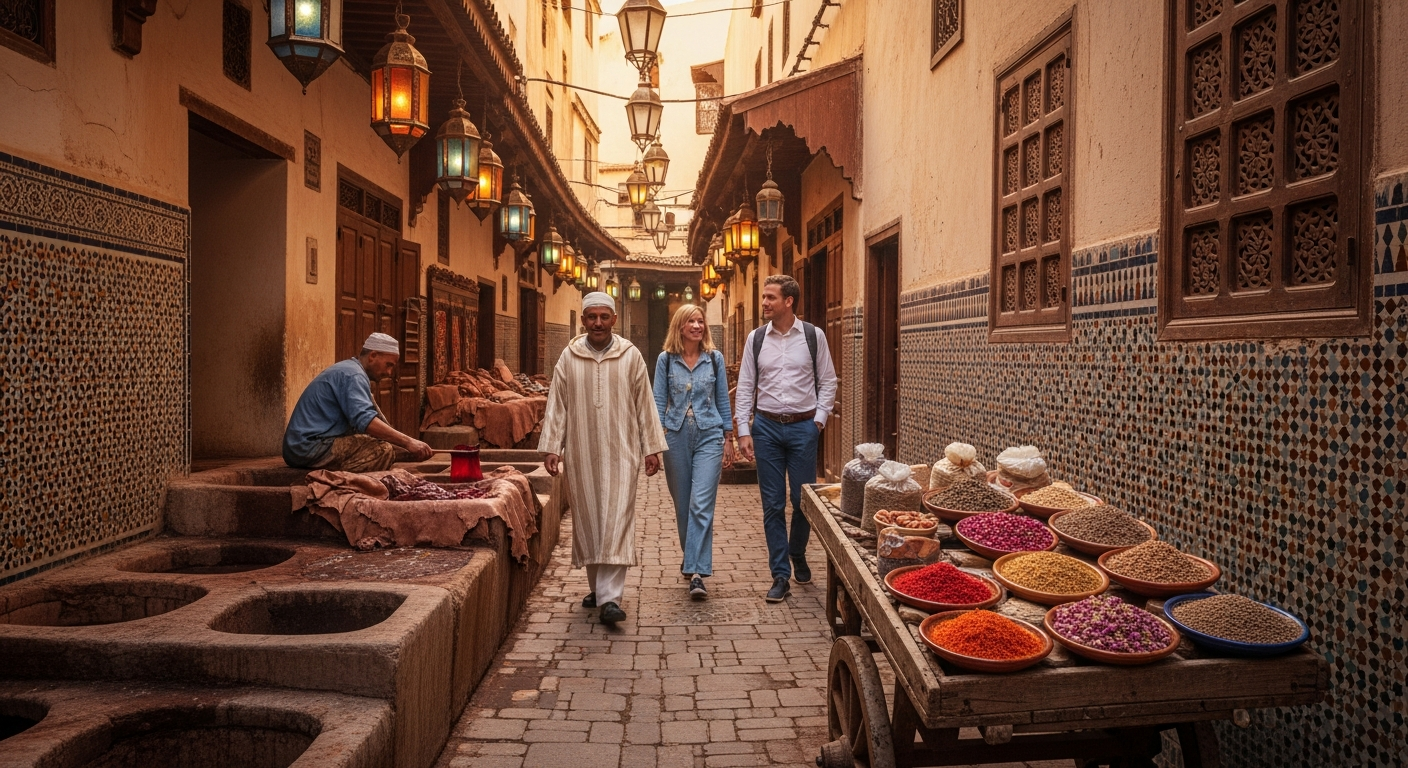
Every Moroccan city has a souk that wakes before sunrise. In Meknes, the Mellah market sells fresh msemen flatbreads for 3–5 dirhams (under $0.50). Vendors arrange mint, preserved lemons, and spiced olives in meticulous rows. Arriving at 7 AM means sharing the space with grandmothers, not tourists. This is not a performance — it is daily life. Joining a local food guide here changes everything. You learn to identify ras el hanout by smell, debate vendors on freshness, and understand why Moroccan olive oil differs by region. It is a masterclass in sensory education delivered through one hour of morning light and honest commerce.
Cooking Classes with Local Families
Marrakech hosts hundreds of cooking schools, but the most valuable are family-led. Fatima Zahra, a home cook in the Derb Dabachi neighborhood, charges €35 per session and teaches three generations of the same tagine recipe. Her class includes a market walk, spice explanation, and a shared meal. Students learn that saffron should never be boiled directly — a mistake most restaurants make. Testimonial from traveler Lena Hartmann (Germany, 2024): *”I have cooked Moroccan food for years. One afternoon with Fatima taught me more than ten cookbooks ever did.”* These intimate kitchens are where real Moroccan cuisine lives.
| Experience | Location | Average Cost | Duration |
|—|—|—|—|
| Morning market walk | Meknes / Marrakech | Free–$10 | 1–2 hours |
| Family cooking class | Marrakech / Fes | $25–$45 | 3–4 hours |
| Communal oven (farran) visit | Old Medina, Fes | Free | 30 minutes |
| Traditional tea ceremony | Chefchaouen | $5–$8 | 1 hour |
—
Artisan Workshops: Learning by Doing
The Tanners of Fes
The Chouara Tannery is famous, but most visitors only observe from terrace shops. Going inside with a licensed guide tells a completely different story. Workers use pigeon dung, quicklime, and natural dyes — a process unchanged since the 11th century. A local tanner named Youssef explained in an interview: *”Every color has a season. Poppy red is autumn. Saffron yellow is year-round. We read the market like farmers read weather.”* Short immersion programs, lasting two to three days, are available through the Association des Artisans de Fes for approximately 800 MAD (~$80). Participants learn basic leather preparation under the guidance of a master craftsman.
Zellige Tile-Making in Salé
Across the Bouregreg River from Rabat lies Salé — often ignored by travelers. Yet it hosts some of Morocco’s finest zellige (mosaic tile) workshops. Master craftsmen, called maalems, spend years perfecting the geometric cuts. A two-hour workshop at Atelier Bensouda costs 350 MAD (~$35) and produces one small tile panel participants keep. The process demands precision — each terracotta piece is hand-chiseled and hand-fitted. It is a moving meditation. Moreover, purchasing directly from the atelier means artisans receive the full margin, not a middleman commission. This model is slowly reviving Salé’s economic identity.
—
Desert and Nomadic Encounters
Beyond the Tourist Camel Ride
Merzouga is the gateway to Erg Chebbi, one of Morocco’s most spectacular Saharan dune fields. Standard camel rides last one hour and return tourists to the same hotel. The local experience involves something far richer. Families from the Ait Khebbach Berber community offer multi-day bivouac stays averaging $60–$90 per night, including camel trekking, star navigation sessions, and traditional Gnawa music around the fire. These are not performances — they are evenings as nomadic families actually live them. A 2024 study by the Atlas Cultural Foundation found that 78% of visitors to community-hosted desert camps reported it as the single highlight of their entire Morocco trip.
Draa Valley: The Forgotten South
South of Ouarzazate, the Draa Valley stretches 200 kilometers through palm oases, kasbahs, and traditional ksour (fortified villages). Fewer than 8% of Morocco’s international tourists visit this region, according to 2023 regional tourism data. Yet local guides here offer multi-day walking itineraries connecting villages where Amazigh culture remains entirely intact. Accommodations are family guesthouses charging 150–250 MAD per night (~$15–$25). Each stop includes a meal prepared from the family’s own garden. The Draa River, where it flows, irrigates date palms that produce Morocco’s finest Medjool dates — sold roadside for a fraction of export prices.
—
Mountain Village Stays in the Atlas
Community Tourism in Aït Benhaddou Region
The High Atlas offers one of Morocco’s most rewarding local experiences: homestay tourism. Organizations like Dar Taliba and Tizi Trek connect travelers with Berber families in villages above 2,000 meters. Costs average $20–$35 per night, fully inclusive of dinner and breakfast. Guides are local men and women trained by NGOs and certified through Morocco’s Office National Marocain du Tourisme (ONMT). A 2025 ONMT report confirmed that community tourism in the Atlas region supports 12,400 local households directly. For travelers, this means waking to fresh-baked khobz bread, mule-herding sounds, and panoramic valley views no five-star hotel can replicate.
> *”The mountains do not advertise themselves. But those who climb them with a local guide discover a Morocco that has not changed in a thousand years.”*
> — Rachid Aït Ouali, licensed Atlas mountain guide, 2024
Hiking Toubkal: The Right Way
At 4,167 meters, Jebel Toubkal is Africa’s highest peak north of the Sahara. Most hikers ascend with Imlil-based agencies. However, hiring a local mule driver and guide from Aroumd village directly eliminates agency markup and keeps income in the community. The two-day ascent costs approximately $80–$110 all-inclusive when booked locally. Importantly, local guides know which gîtes serve homemade harira soup — a warmth that GPS cannot locate.
—
Hammam Culture: The Social Bath
A Ritual, Not a Spa Treatment
Moroccan hammams divide into two categories: tourist spas and neighborhood baths. The latter cost 10–20 MAD (~$1–$2) and operate on a social logic entirely different from the former. Men and women attend on alternating schedules. Regulars bring their own kessa (exfoliating glove) and beldi soap made from black olive oil. In neighborhood hammams of Casablanca’s Maarif district or Rabat’s Hassan quarter, conversations happen between strangers as a matter of course. Anthropologist Dr. Nadia Benkirane (University of Rabat, 2023) describes it as *”the only truly democratic space in Moroccan urban life — where class dissolves in steam.”* Entry cost: almost nothing. Cultural insight: invaluable.
—
FAQs
Q1: When is the best time to visit Morocco for authentic local experiences?
September to November and March to May offer ideal weather. Festivals like Moussem of Tan-Tan (May) and Festival of Roses in Kelaa M’Gouna (April–May) add cultural depth.
Q2: Is it safe to explore local neighborhoods alone in Morocco?
Generally yes. Major medinas are safe by day. Evening navigation benefits from a local contact or guided introduction. Women travelers should note that guided tours in the first visit reduce unwanted attention significantly.
Q3: How much should I budget for authentic local experiences?
A daily budget of $40–$70 covers locally owned accommodation, food, and one cultural activity. This is substantially less than tourist-facing options.
Q4: Do I need to speak Arabic or Darija to connect with locals?
No. Basic French works across most cities. In the Souss and Atlas, Tamazight greetings are warmly received. A few words in Darija — *shukran* (thank you), *bslama* (goodbye) — open doors.
Q5: Are local experiences environmentally responsible?
Community-based tourism models consistently rank higher in sustainability metrics. The UNWTO 2024 report identified Morocco’s Atlas homestay network as a regional benchmark for responsible tourism.
—
Conclusion
Morocco rewards those who look past the obvious. The best local experiences in Morocco are not hidden — they simply require intention. Choose the neighborhood hammam over the hotel spa. Hire the village guide instead of the city agency. Eat where the taxi driver eats. Every one of these choices multiplies your understanding of a country that is ancient, layered, and deeply generous to those who approach it with respect. The experiences described in this article are not extraordinary. They are ordinary Moroccan life, made accessible. And that, ultimately, is the point.
—
References
– Moroccan Ministry of Tourism (2023). *Tourism Revenue and Visitor Statistics Report*. Available via: tourisme.gov.ma
– World Tourism Organization – UNWTO (2024). *Community Tourism and Traveler Satisfaction Index*. Available via: unwto.org
– Atlas Cultural Foundation (2024). *Desert Tourism Community Impact Study, Merzouga Region*. Internal publication.
– Office National Marocain du Tourisme – ONMT (2025). *Atlas Homestay Network Annual Report*. Available via: visitmorocco.com
– Benkirane, N. (2023). *Urban Ritual and Social Space in Moroccan Hammam Culture*. University of Rabat Press.
– UNESCO World Heritage Centre. *Medina of Fez – Property Description*. Available via: whc.unesco.org